
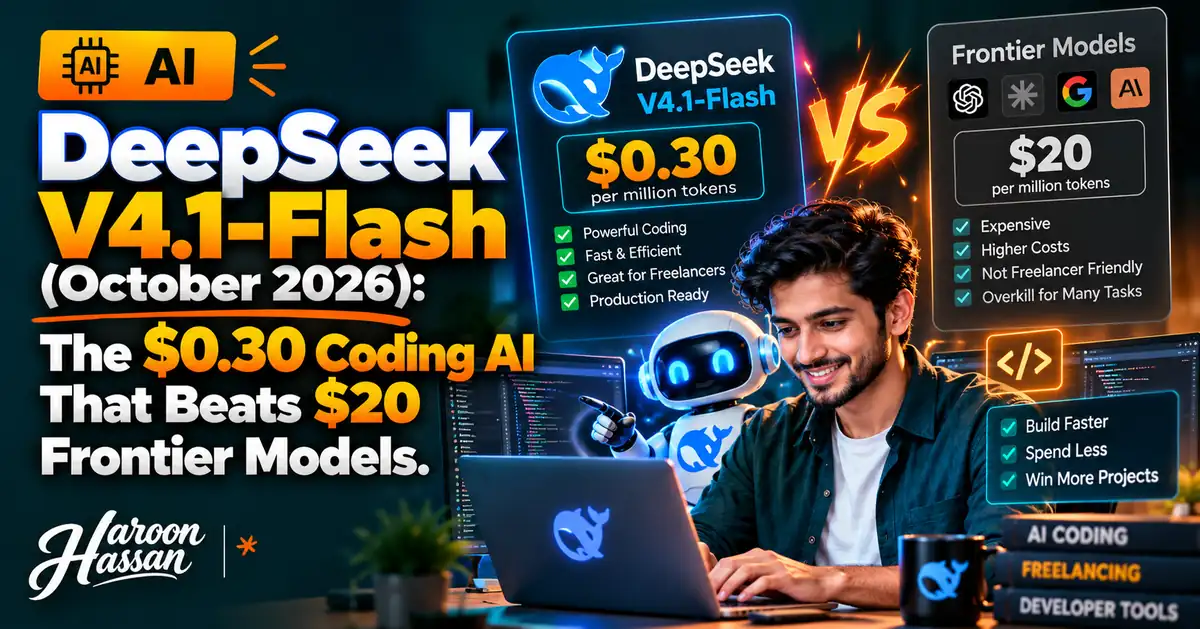
On October 17, 2026, Chinese AI company DeepSeek released an updated checkpoint of its smallest current model, DeepSeek-V4.1-Flash-1017. While this is not an entirely new model family, the update delivers notable improvements in coding, agentic workflows, and cost efficiency.
The results are attracting attention. According to Arena.ai's Code Arena WebDev leaderboard, the updated model scored 1670, ranking first among open models and 12th overall. It reportedly outperformed Moonshot AI's Kimi K3 (Max) and several closed frontier models on specific coding benchmarks.
For freelance developers, however, the biggest attraction may be its price. DeepSeek-V4.1-Flash-1017 costs approximately 33 times less than GPT-5.6 Sol and 42 times less than Claude Opus 5 on the off-peak output-token pricing comparisons discussed in this article.
For developers who regularly use AI coding agents, that difference could significantly reduce operating costs.
What Happened on October 17, 2026?
DeepSeek announced the update in its API changelog on October 17, 2026. The release, named DeepSeek-V4.1-Flash-1017, is a refreshed checkpoint of DeepSeek-V4.1-Flash, originally launched in September 2026.
The updated model became available through DeepSeek's website, app, and API on the same day. Developers using the existing deepseek-flash API name did not need to change their code because the name now points to the new checkpoint.
DeepSeek described the release as a "Pareto improvement in performance and cost." In practical terms, this means improved performance without a corresponding increase in cost.
The model weights are also available on Hugging Face under the permissive MIT license, making the release relevant to developers interested in open-weight AI models.
Another notable development is DeepSeek's decision to open its in-house web search engine to external developers through API endpoints. This allows developers to build AI agents that retrieve live web information without relying on a separate search provider.
DeepSeek V4.1-Flash-1017: Benchmark Results
DeepSeek's October 17 comparison table reports improvements across three benchmarks compared with the September release.
| Benchmark | September Release | October 17 Update |
|---|---|---|
| DeepSWE v1.1 (agentic coding) | 74.2 | 77.0 |
| Terminal-Bench 4.0 (terminal tasks) | 31.2 | 42.3 |
| Automation-Bench (workflow automation) | 54.8 | 60.5 |
The DeepSWE v1.1 score is particularly noteworthy. In DeepSeek's comparison, the updated model scored 77.0, ahead of Claude Opus 5 at 74.0 and GPT-5.6 Sol at 73.0.
Independent evaluations have also reported encouraging results. On October 18, Arena.ai announced that the model achieved a score of 1670 on Code Arena WebDev, placing it at the top of the open-model rankings. It was reported to be approximately 10 times cheaper to run than Kimi K3 (Max), which it displaced.
Browser Use also evaluated the model on 180 long-horizon browser tasks. DeepSeek-V4.1-Flash-1017 reportedly scored 75.0 at $0.22 per task, matching Claude Opus 5.5's score while costing $2.35 per task for the comparison model. That represents approximately 10 times lower cost per task. Browser Use described the model as "the new pareto frontier."
These results suggest that lower-cost models may increasingly handle practical coding and browser-based workflows. However, benchmark performance should always be considered alongside independent testing and real-world reliability.
DeepSeek V4.1-Flash Pricing: How Much Does It Cost?
Cost efficiency is one of the model's most compelling features for developers who run AI agents regularly. The reported API pricing for DeepSeek-V4.1-Flash-1017 is:
| Token Type | Price per 1 Million Tokens |
|---|---|
| Input tokens | $0.30 |
| Output tokens | $1.20 |
| Off-peak output tokens | $0.60 |
For comparison, GPT-5.6 Sol is listed at $20 per million output tokens, while Claude Opus 5 costs $25. Based on these figures, DeepSeek's standard output pricing is approximately 1/17th the cost of GPT-5.6 Sol and 1/21st the cost of Claude Opus 5. The comparison becomes approximately 1/33rd and 1/42nd at the $0.60 off-peak rate.
For typical AI coding-agent tasks, the reported cost ranges from $0.12 to $0.22, depending on the thinking configuration. Consider a freelancer running 20 coding-agent tasks daily to debug client websites, generate landing pages, or refactor code. At approximately $0.20 per task, the daily cost would be around $4. At $2.35 per task, the comparison would be approximately $47 daily.
Over a month, the difference could become substantial, particularly for freelancers earning in Pakistani rupees while managing international project costs. Actual expenses will vary with token usage, model settings, task complexity, and API pricing.
What This Means for Freelance Web Developers in Pakistan
Affordable AI coding models could change the economics of freelance web development in three important ways.
1. Client Prototypes Become More Affordable
Developers can use AI coding agents to generate landing pages, WordPress theme mockups, and interactive client demonstrations at a low cost. Faster prototyping can help freelancers prepare proposals more efficiently, demonstrate ideas to prospective clients, and explore more project opportunities. The quality of the final deliverable will still depend on testing, customization, and professional review.
2. Debugging Becomes More Cost-Efficient
A PHP error, broken JavaScript slider, or CSS layout issue can consume valuable development time. When each AI-assisted attempt costs only a few cents, developers can test alternative solutions, explore different implementations, and iterate more frequently without spending as much on model usage. This is especially useful for routine debugging and repetitive development tasks, although complex problems may still require stronger models or additional human expertise.
3. Smaller Client Projects Can Become More Profitable
Small businesses in Pakistan often operate with limited budgets and cannot always pay Western development rates. Lower AI coding costs may improve margins on fixed-price projects for local shops, restaurants, and startups. Freelancers can potentially deliver prototypes and routine development work more efficiently while maintaining professional quality standards.
Security warning: Never paste client secrets, API keys, database passwords, or proprietary business code into an AI chat without appropriate authorization and safeguards. Remove credentials before sharing code, and review every AI-generated change before deploying it to a live website. Low-cost AI does not eliminate the need for code review.
How to Start Using DeepSeek V4.1-Flash in 5 Steps
You can begin experimenting with the model without immediately rebuilding your development workflow.
- Try the free chat interface. Visit DeepSeek and test a small coding task, such as creating a pricing table or contact form. Evaluate the output yourself.
- Obtain an API key. If you want to integrate the model with your editor or AI-agent tools, use DeepSeek's developer platform. The model name is
deepseek-flash. - Set a spending limit. AI agents can sometimes enter long execution loops. Configure a daily spending cap where available to reduce the risk of unexpected API costs.
- Test it on your own codebase. Use a real development task, such as fixing a bug or refactoring a file. Compare the results with your existing AI coding model.
- Track the cost per task. Record token usage, correction time, and results for a week. The article's estimate is that the updated Flash can handle 80–90% of daily coding work for many freelancers, leaving more expensive frontier models for the hardest problems. Treat this as an estimate to test against your own workload rather than a universal guarantee.
The Limitations You Should Know
Despite the promising performance and pricing, DeepSeek-V4.1-Flash-1017 is not the ideal choice for every task.
Most Reported Benchmarks Come From DeepSeek
Many of the headline figures come from DeepSeek's own benchmark comparisons. Independent evaluations are emerging, but additional replication is needed. Treat vendor-reported scores as useful evidence, not conclusive proof of universal superiority.
Frontier Models Still Lead in Some Categories
DeepSeek's own comparison table shows Claude Opus 5 ahead on several benchmarks: HLE without tools (56.3 versus 42.6), Terminal-Bench 4.0 (51.8 versus 42.3), ProgramBench (37.0 versus 29.1), and NL2Repo-Bench (75.3 versus 68.2). For particularly difficult reasoning, programming, and repository-level tasks, more expensive models may still provide better results.
Running the Model Locally Is Not Practical for Most Developers
With 763 billion total parameters, this is not a model most developers can simply download and run on a standard laptop. Most users will access it through DeepSeek's official API or a third-party provider rather than operating the complete model locally.
These limitations do not eliminate its potential value. An open-weight, MIT-licensed coding model that delivers competitive results on practical web development tasks at a fraction of the cost could offer freelancers a meaningful business advantage.
Explore More AI Tools
Want to discover more AI tools that can reduce your freelance development costs? Browse the AI Tools Directory — 100 tools across 10 categories, with practical notes for Pakistani freelancers, creators, and students.
Explore the AI Tools DirectoryFrequently Asked Questions
What is DeepSeek V4.1-Flash-1017?
DeepSeek-V4.1-Flash-1017 is an updated checkpoint of DeepSeek's V4.1-Flash model, released on October 17, 2026. It is described as DeepSeek's smallest current model, designed for fast, affordable coding and agentic tasks. Its weights are published on Hugging Face under the MIT license.
Is DeepSeek V4.1-Flash better than GPT and Claude for coding?
On specific coding benchmarks, the updated model performs competitively. It scored 77.0 on DeepSWE v1.1, ahead of Claude Opus 5 at 74.0 and GPT-5.6 Sol at 73.0, and ranked first among open models on Code Arena WebDev. However, Claude Opus 5 leads on several other benchmarks, so the best choice depends on the task.
How much does DeepSeek V4.1-Flash cost?
The reported API price is $0.30 per million input tokens and $1.20 per million output tokens, with off-peak output pricing of $0.60 per million tokens. Its standard output price is approximately 1/17th of GPT-5.6 Sol's and 1/21st of Claude Opus 5's; at off-peak pricing, it is approximately 1/33rd and 1/42nd, respectively. Actual task costs depend on usage.
Can I use DeepSeek V4.1-Flash for free?
You can try the model through DeepSeek's free chat app at deepseek.com. API usage is paid, although typical agent tasks are reported to cost approximately $0.12–$0.22.
Is DeepSeek V4.1-Flash open source?
The model weights are published on Hugging Face under the MIT license, which permits broad use subject to the license terms. However, its 763-billion-parameter size makes local operation demanding, so most users will likely rely on an API or third-party provider.