
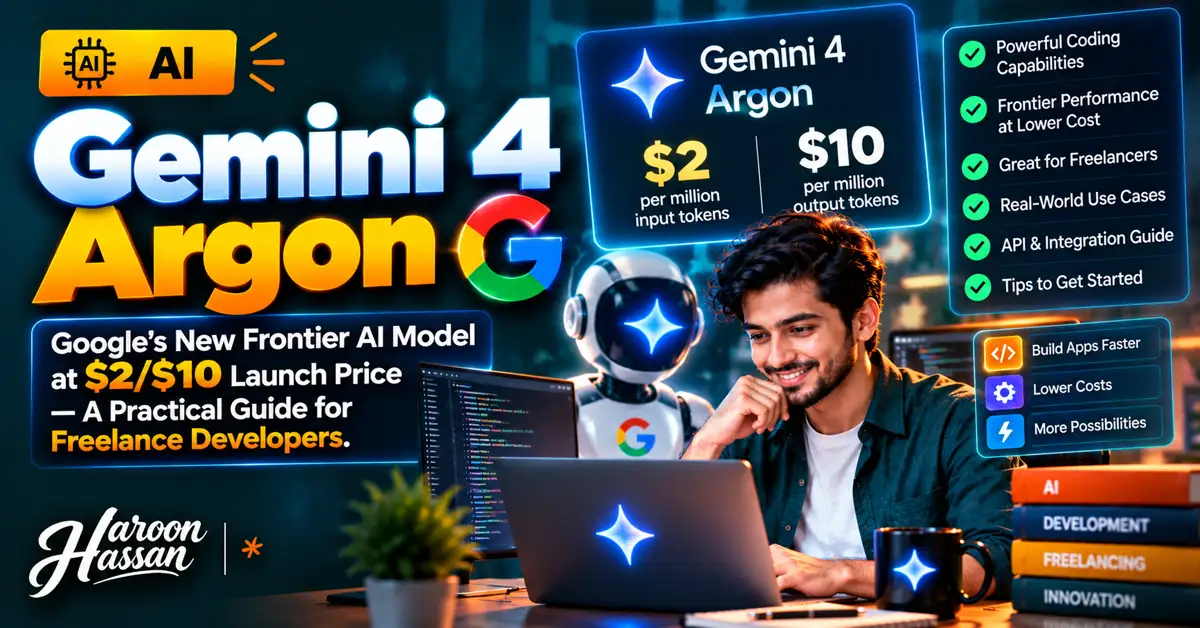
Google has made its latest frontier AI model available to developers — and its introductory pricing creates an opportunity worth examining. On October 13, 2026, Gemini 4 Argon became generally available, bringing Google's newest frontier model to paying developers through its API and to GitHub Copilot users.
The model was initially restricted to a small group of cybersecurity defenders. Now, developers can use it for demanding coding tasks, complex reasoning, and enterprise knowledge work.
For freelance developers and students in Pakistan, however, one detail deserves immediate attention: Gemini 4 Argon's introductory API pricing doubles on December 1, 2026. Its current standard rates are $2 per million input tokens and $10 per million output tokens. After November 30, those rates increase to $4 and $20, respectively. That makes the introductory period a useful window to evaluate the model against your actual workload before deciding whether it belongs in your development toolkit.
In this guide, we will cover Gemini 4 Argon's capabilities, pricing, availability, benchmark performance, and five practical takeaways for freelance developers.
What Is Gemini 4 Argon?
Gemini 4 Argon is Google's newest and most capable model line, announced on September 30, 2026, and made generally available on October 13. Google designed the model for three major use cases:
- Advanced coding — handling lengthy programming tasks and multi-step development workflows.
- Enterprise knowledge work — processing legal and financial information, analyzing long documents, and supporting complex knowledge-based tasks.
- Cyber defense — assisting with cybersecurity-related work.
Before its public launch, Argon spent its first two weeks in Google's Fairwind program, where access was limited to cybersecurity partners. Unlike a lightweight chatbot designed primarily for quick questions, Argon targets demanding workflows in which an AI model must understand a task, plan its approach, modify files, and test code across multiple steps. This approach is particularly relevant to developers using AI agents to automate parts of their software development process.
Google positions Gemini 4 Argon against competing frontier models, including OpenAI's GPT-6 Astra and Anthropic's Claude Opus 5.5. However, the best model for a particular project depends on the task, performance requirements, and total operating cost — no single model wins everywhere.
Gemini 4 Argon Pricing: What Developers Need to Know
Pricing is one of the most important factors to consider before integrating Argon into a freelance workflow. Here are the current API pricing tiers, per million tokens:
| Tier | Input | Output | Through Nov 30, 2026 |
|---|---|---|---|
| Standard | $2.00 | $10.00 | Doubles to $4 / $20 on Dec 1 |
| Batch / Flex | $1.00 | $5.00 | Half price; trades speed for savings |
| Priority | $3.60 | $18.00 | Faster, more reliable responses |
| Cached input | $0.10 | — | 95% discount on already-processed text |
The key date to remember: starting December 1, 2026, standard API pricing doubles to $4 input and $20 output per million tokens, matching Claude Opus 5.5's stated price. A business case built on $2 and $10 is only valid for about six more weeks.
Tip: there is no free tier for Argon. Free API keys cannot call it, and in AI Studio you need Google AI Ultra or a paid API key. If you want to try the model without a new subscription, GitHub Copilot is the easiest route (see below).
Two more pricing details that matter. First, output prices include thinking tokens — the model's internal reasoning. In one independent full test run, roughly 72% of the output bill came from thinking tokens, so tasks with heavy reasoning can cost noticeably more than the headline number suggests. Second, cached input is billed at just $0.10 per million tokens, so workflows that resend the same large context repeatedly get much cheaper when caching is used.
Where Can You Use Gemini 4 Argon?
- Gemini API and Google AI Studio (paid tier with billing enabled) — the model ID is
gemini-4-argon. - GitHub Copilot — available across four Copilot plans for coding, agentic and reasoning tasks; no separate Google account needed.
- Gemini app and AI Mode in Search — for Google AI Pro and Ultra subscribers.
- Google Antigravity (Google's agentic coding environment) — for Ultra subscribers.
- Vertex AI — the Model Garden route if you need enterprise data-residency options.
Heads-up on availability: while Google's marketing mentions AI Pro subscribers for the Gemini app, the API pricing docs state Argon is not available on the free tier or the Google AI Pro plan in AI Studio — there you need Ultra or a paid API key. If your workflow lives in AI Studio, plan on paying.
Gemini 4 Argon Benchmarks: How Does It Compare?
Google's own benchmark tables report that Argon leads on knowledge work, long-document processing, and video understanding, while trailing on terminal-driven coding and science tasks. As always, vendor numbers deserve a second opinion.
On Artificial Analysis's independent index, Argon scores 53 — tied with GPT-6 Astra and trailing Claude Opus 5.5 (58). A practical way to read this: Argon is priced like a mid-tier model at launch but performs in the frontier range, making it arguably the best-value frontier option right now. No single model wins on everything, which is why testing on your own most common task matters more than any leaderboard.
5 Practical Takeaways for Freelance Developers in Pakistan
1. Test it during the cheap window, not after
Until November 30, Argon costs half of its December price. Run your evaluation now: pick your most common task, try Argon and one competitor on it, and compare the real cost per task — not just the token price.
2. If you use GitHub Copilot, switching costs nothing extra
Argon is already in Copilot across four plans. You do not need a Google account or a new subscription to try it — just select it as your model and code as usual. This is the lowest-friction way for most developers to experience it.
3. Watch the thinking-token tax
Because reasoning tokens are billed as output at $10 per million, tasks that trigger long internal reasoning — complex debugging, multi-step refactors — can cost several times the visible answer. For budget-sensitive client work, track per-task cost, not per-token price.
4. Use Batch or Flex tiers for non-urgent work
At $1/$5, batch processing cuts API cost in half again. Overnight code analysis, document summarization, and backlog triage are perfect candidates — speed does not matter, the discount does.
5. Cache aggressively
At $0.10 per million cached input tokens, reusing previously processed context — your codebase structure, project docs — is nearly free. Any agent workflow that resends the same large context repeatedly gets dramatically cheaper with caching enabled.
Explore More AI Tools
Want to discover more AI tools that can reduce your freelance development costs? Browse the AI Tools Directory — 100 tools across 10 categories, with practical notes for Pakistani freelancers, creators, and students.
Explore the AI Tools DirectoryFrequently Asked Questions
Is Gemini 4 Argon free to try?
No. There is no free API tier, and in AI Studio it requires Google AI Ultra or a paid API key. The cheapest way to try it is through GitHub Copilot if you already have a plan that includes it.
How does Gemini 4 Argon compare with GPT-6 Astra?
Both score 53 on Artificial Analysis's independent index; Claude Opus 5.5 scores 58. Per-token, Argon costs a fraction of GPT-6 Astra at launch pricing. Each model leads on different tasks, so test on your own workload.
How much will it cost after November 30, 2026?
From December 1, 2026, the standard API price doubles to $4 per million input tokens and $20 per million output tokens — the same as Claude Opus 5.5's stated price.
Can I use Gemini 4 Argon in Pakistan?
Yes. Google describes the release as globally available through the paid Gemini API, AI Studio, GitHub Copilot, and the Gemini app for subscribers. API access requires a billing-enabled Google Cloud account.
Is it good for coding?
Coding is its headline use case, and Google positions it for long coding jobs and agentic workflows. However, Google's own benchmarks show it trailing on terminal-driven coding tasks — test before standardizing.