
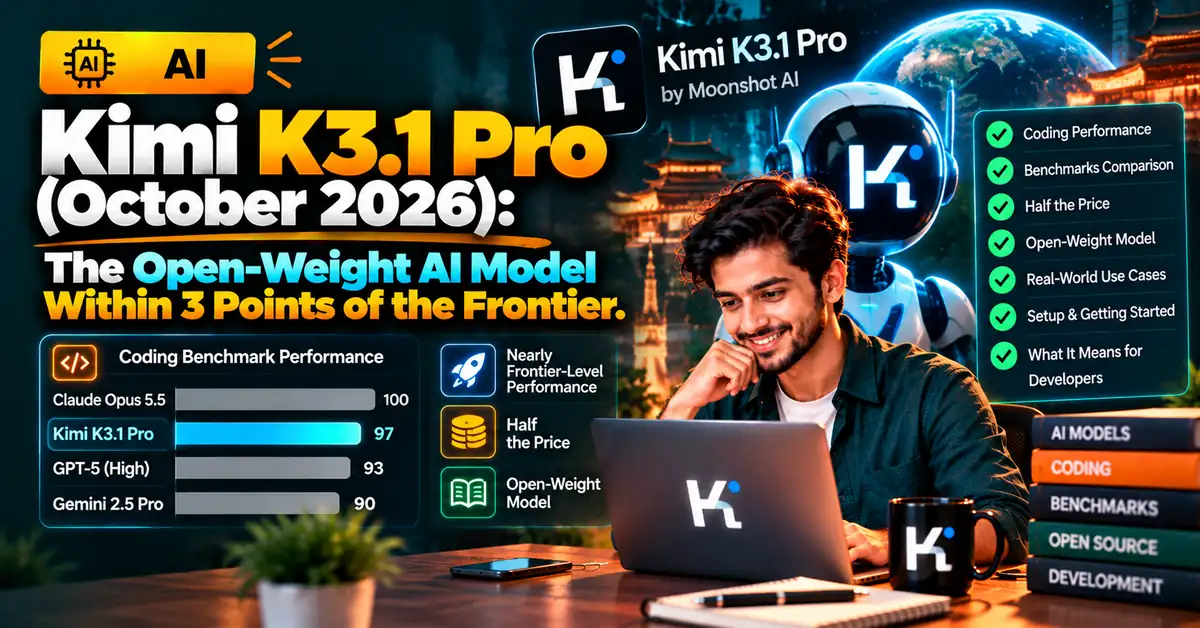
On October 23, 2026, Beijing-based Moonshot AI introduced Kimi K3.1 Pro, a powerful AI model that is bringing open-weight artificial intelligence closer to the industry's leading closed models.
The release ranked fourth on the Artificial Analysis Intelligence Index with a score of 55, behind Anthropic's Claude Opus 5.5, Claude Sonnet 5.5, and Meta's Muse Wonder Full.
For freelance developers, the headline is not just the ranking. Kimi K3.1 Pro is designed to become an open-weight model, with its full weights expected to be published by November 4, 2026. If released as announced, it would become the highest-scoring open-weight model on the index, reducing the gap between the leading open and closed models from 12 points to just three.
That combination of coding performance, a million-token context window, and competitive API pricing makes Kimi K3.1 Pro worth watching — particularly for developers in Pakistan who need capable AI tools without unnecessary spending.
Here is what you need to know about its architecture, benchmark results, pricing, limitations, and practical applications.
What Is Kimi K3.1 Pro?
Kimi K3.1 Pro is a post-trained version of Kimi K3, the 2.8-trillion-parameter model that Moonshot AI released with open weights in July 2026. At the time, Kimi K3 was described as the largest open-weight model available.
The Pro version retains the same model class, with 2.8 trillion total parameters and 104 billion active parameters per token, alongside a 1-million-token context window.
The key improvement lies in post-training. Moonshot invested substantially more computing resources in reinforcement learning, long-context inference, and the sandbox environments used by coding agents to execute code.
Kimi K3.1 Pro is already accessible through several platforms:
- The Kimi app and website at kimi.ai.
- The Kimi Work desktop application.
- Kimi Code, a programming agent.
- The Kimi API, using the model IDs
kimi-k3.1-proandkimi-k3.1-pro-highspeed.
Users can select among three reasoning levels: low, medium, and max. These settings allow developers to adjust the balance between response speed and reasoning depth.
Why the 1-Million-Token Context Window Matters
One of Kimi K3.1 Pro's most significant features is its ability to process up to one million tokens of context.
This can allow a developer to provide an entire small codebase, extensive project documentation, or months of project-related material within a single context window.
Instead of repeatedly splitting files into smaller sections because of context limitations, developers can analyze larger collections of information together.
For repository reviews, debugging, documentation, and complex project analysis, this capability could make AI-assisted development more practical.
Kimi K3.1 Pro Benchmarks: How Close Is It to Frontier AI?
Moonshot's benchmark results attracted substantial attention, reportedly generating approximately 850 points on Hacker News and nearly 500 comments by Friday evening.
These figures primarily come from Moonshot's announcement, so they should be interpreted with the usual caution associated with vendor-reported benchmarks.
Terminal-Bench 4.0: Competitive Coding Performance
Terminal-Bench 4.0 evaluates AI agents on realistic terminal-based tasks.
| AI Model | Reported Score |
|---|---|
| Claude Opus 5.5 | 66.4% |
| Kimi K3.1 Pro | 65.7% |
| GPT-6 Astra | 58.2% |
Kimi K3.1 Pro trails Claude Opus 5.5 by just 0.7 percentage points while outperforming GPT-6 Astra on this benchmark.
Artificial Analysis also reran the model using a neutral evaluation setup and measured a score of 67.2%, the highest result on its board at the time described.
SWE-Marathon and Kimi Code Bench 3.0
Moonshot reports that Kimi K3.1 Pro scores 51.7% on SWE-Marathon, ahead of Claude Opus 5.5 at 46.3%.
On Moonshot's long-horizon coding benchmark, Kimi Code Bench 3.0, the model improved from 55.95% with Kimi K3 to 61.2% with Kimi K3.1 Pro.
These results suggest potential benefits for developers working on extended coding tasks, debugging sessions, and multi-file software changes.
Where Kimi K3.1 Pro Still Falls Behind
The model does not lead across every category.
On Terminal-Bench Science, Kimi K3.1 Pro scores just 38.1%, compared with 68.1% for GPT-6 Astra and 63.3% for Claude Opus 5.5.
On BenchCAD, which evaluates the reconstruction of 3D objects as CAD code, it achieves 92.7% with tools. Claude Opus 5.5 scores 96.2%, while GPT-6 Astra scores 95.9%.
For scientific computing, advanced mathematics, and specialized technical workflows, these results suggest that closed frontier models may retain important advantages.
An important caveat about the benchmarks. Most of these scores come from Moonshot's own announcement, and the comparisons were largely run inside Anthropic's Claude Code harness, with rivals' scores taken from published reports. Independent results will firm up after November 4, when anyone can test the open weights directly.
Kimi K3.1 Pro Pricing: Is It Really Cheaper?
Kimi K3.1 Pro's API pricing is:
| Pricing Metric | Cost |
|---|---|
| Input tokens | $2 per million |
| Output tokens | $10 per million |
| Highspeed input | $4 per million |
| Highspeed output | $20 per million |
The standard API rate is half the stated pricing of Claude Opus 5.5.
The Highspeed version is marketed as two to three times faster, although independent measurements reportedly put the actual speed improvement closer to 1.5–1.8 times.
There is an important distinction between cheaper tokens and cheaper completed tasks.
Artificial Analysis estimates K3.1 Pro's cost at approximately $1.98 per Intelligence Index task, roughly the same as Kimi K3. The reason is that K3.1 Pro generates around 55,000 output tokens per task — 14% more than K3.
Consequently, lower token prices do not necessarily translate into lower total costs.
Practical tip: compare cost per completed task, not cost per token. Run the same client workflow through K3.1 Pro and your usual frontier model and measure the total price of a successful result — a model that uses far more tokens can erase its apparent pricing advantage.
Even so, Kimi K3.1 Pro offers capabilities in a pricing category comparable to Claude Sonnet 5.5, GPT-6.1 Sol, and Gemini 4 Argon, making it an option for developers seeking frontier-adjacent performance at a mid-tier price.
What Does Open-Weight AI Mean for Freelancers?
An open-weight model makes its learned model parameters available for download, allowing users with suitable hardware to run it independently rather than relying exclusively on the original provider's servers.
Potential benefits include greater control over deployment, reduced dependence on a single API provider, and the ability to keep data within an organization's own infrastructure.
However, Kimi K3.1 Pro's 2.8-trillion-parameter size presents a substantial hardware challenge. Most freelancers will find the API and free Kimi applications more practical than operating the full model locally.
The planned weight release still matters because it could provide a deployment alternative for organizations with strict data-handling requirements.
The broader trend is also notable. Hugging Face's 2026 report found that open models developed in China accounted for 41% of platform downloads, compared with approximately 35–36.5% for US-developed models. One publication characterized the shift following Kimi K3's launch by stating, "America's commanding lead in advanced AI is gone."
Kimi K3.1 Pro represents another development in this increasingly competitive open-model landscape.
5 Ways Freelance Developers Can Use Kimi K3.1 Pro
- Automate complex coding tasks. Use Kimi Code or another compatible coding agent for multi-file refactoring, debugging, and feature development. Its Terminal-Bench results suggest that it can handle realistic terminal-based tasks.
- Review entire codebases. Use the million-token context window to analyze larger repositories, investigate security issues, identify potential performance problems, or generate documentation.
- Prepare client research and proposals. Provide relevant client information, project requirements, and previous work to help develop a scoped proposal with realistic estimates. Some early users have described Kimi as more argumentative than competing US models. That tendency to challenge assumptions can be useful during planning, provided you review its conclusions before presenting them to clients.
- Get a second opinion from AI. Run the same prompt through Kimi K3.1 Pro and your usual frontier model, then compare accuracy, completeness, and total cost. At the standard $2/$10 pricing, this can be a practical way to evaluate alternative approaches.
- Explore self-hosting after November 4. Once the full weights are released as expected, developers can investigate local or server-based deployment for clients with strict data requirements. Hardware requirements and licensing conditions should be evaluated before deployment.
Limitations Freelance Developers Should Consider
Before making Kimi K3.1 Pro your default model, keep four limitations in mind:
- Benchmark independence: Moonshot conducted most comparisons using Anthropic's Claude Code harness and sourced competing scores from published reports. Independent testing should provide more evidence after the expected November 4 weight release.
- Scientific reasoning: its 38.1% Terminal-Bench Science score indicates a significant weakness relative to the cited frontier competitors.
- Communication style: early users describe Kimi as comparatively argumentative. Review its tone before using it in client-facing workflows.
- Weight availability: the full K3.1 Pro weights have not yet been released. Until they are available, practical access is through the API and Kimi applications.
Final Thoughts: Is Kimi K3.1 Pro Worth Trying?
Kimi K3.1 Pro brings open-weight AI closer to leading closed models, combining competitive coding benchmarks, a million-token context window, and relatively accessible API pricing.
For freelance developers in Pakistan, the most practical approach is to test it on a real project, measure the cost of completed tasks, and compare its output with existing tools before adopting it for client work.
Try it through kimi.ai, and keep November 4, 2026, on your calendar for the expected release of the full model weights. If the release proceeds as announced, it could give developers another option for deploying powerful AI models with greater control over their infrastructure.
Building AI-powered features for clients?
Explore the free AI Tools Directory to discover tools for freelancers, creators, and developers — and if you need a custom automation workflow, visit the contact page to discuss your project.
Explore AI ToolsFrequently asked questions
What is Kimi K3.1 Pro?
Kimi K3.1 Pro is Moonshot AI's advanced model released on October 23, 2026. It has 2.8 trillion total parameters, 104 billion active parameters per token, and a one-million-token context window. It ranks fourth on the Artificial Analysis Intelligence Index with a score of 55.
Is Kimi K3.1 Pro free to use?
The model is available through the Kimi app and website, while API usage costs $2 per million input tokens and $10 per million output tokens. The full weights are expected to be available for free download by November 4, 2026.
How does Kimi K3.1 Pro compare with Claude Opus 5.5?
On Terminal-Bench 4.0, Kimi K3.1 Pro scores 65.7%, compared with 66.4% for Claude Opus 5.5. It leads on SWE-Marathon, scoring 51.7% against 46.3%, but trails on Terminal-Bench Science, where the scores are 38.1% and 63.3%, respectively. Performance depends on the task.
When will Kimi K3.1 Pro's open weights be released?
Moonshot AI expects to publish the full weights by November 4, 2026. According to Artificial Analysis's reported rankings, the release would make it the highest-scoring open-weight model available.
Can I run Kimi K3.1 Pro on my own computer?
Potentially, once the weights are released, but the 2.8-trillion-parameter model requires substantial server hardware. A typical laptop is not a practical option for running the full model. Most freelancers will find the Kimi API or free Kimi applications more accessible.